
Claude designs.
Unstackr makes it operable.
Take designs that Claude or Gemini produces and have Unstackr lift out the fields, rules, calculations and integrations, and rebuild them as editable objects on the Unstackr design surface. The object are then deployed as a governed application your team can manage and update. Data model, integrations and field control are now low code options for you to move between Unstackr and AI.
What we solve forRunning and maintaining Claude designs made possible with Unstackr
A model can produce a working intake application in an afternoon. What arrives is a codebase, and a codebase is only useful to the people who can build, host, secure and change it. For most teams, the prototype stalls exactly where the real work starts.
01Only the model can change it
Every amendment goes back through a prompt. Business owners can't touch a field label, a threshold or a dropdown list without a developer in the loop.
02The rules are buried again
Eligibility thresholds and calculations end up inside functions and conditionals. You've swapped logic locked in a PDF for logic locked in a file - same problem, newer syntax.
03No path to production
Hosting, accessibility, authentication, retention, audit trails and language support are all still ahead of you, and none of them come out of the model.
04It stands apart from the estate
One generated app doesn't share connectors, rules or a data layer with the forms around it. Build ten and you've built ten more silos.
What comes out of the codeEvery part of the output becomes something you can open and edit.
Unstackr parses the generated HTML application and materialises each construct as a first-class object in App Manager. Nothing is re-implemented by hand and nothing stays trapped in a function body - the logic keeps a link back to the source it came from.
After intakeThe generated Claude HTML arrives as an editable application.
Same design surface, same rules engine, same integration layer the rest of your form estate already runs on. There is no separate “AI project” to look after.
Fields become controls. Every input in the generated code lands on the page as a typed control with its own properties - tag, data type, format, required, secured - alongside the standard palette, drawings, data and advanced elements.
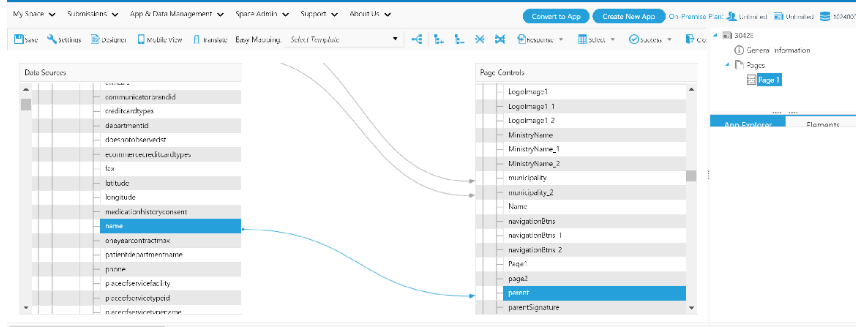
Calls become connections. Each API, database or service call in the output is registered as a data source and wired to the controls it feeds, in both directions, with response and success handling defined in the same view.
How it worksFrom generated Claude HTML output to a running service.
01Generate your Claude HTML
Hand Unstackr the application Claude produced - a repository, a folder, or a single generated file. No scaffolding or restructuring first.
02Extract the logic
The agents read the code and build a model of it: every field, condition, calculation, validation, service call and string, each linked back to where it came from.
03Rebuild as objects
The model is written into App Manager as pages, controls, properties, business rules and data mappings. High-risk logic is flagged for a person to confirm.
04Deploy and operate
Publish as a responsive web and native mobile app on your tenancy, then keep changing it in the tool - new fields, new rules, new integrations, no regeneration.
What the platform addsEverything the model doesn't hand you.
Generated HTML stops at the demo. These are the parts an application needs before it can carry real submissions from real people - and they come with the platform rather than the prompt.
-
Conditions, branching and cross-field logic as named rules an analyst can read, test and change.
-
Databases, web services, APIs and file drops defined once in the space and shared by every application in it.
-
One build renders as a responsive web app and in the native iOS and Android app, with offline capture and sync.
-
Output is WCAG 2.0 AA compliant HTML5 rather than something to remediate after the fact.
-
Translate every label, hint and message from one source and follow the user's language preference.
-
Mark sensitive inputs as secured and control who can design, submit and administer through space administration.
-
Completed data is stored, searchable and routable, with print and Download PDF output where a document is still required.
-
Changes are released individually against a versioned platform, with an audit trail on what the agents decided and what a person approved.
-
SaaS, PaaS or fully on-premises, on the cloud provider of your choice, under ISO 27001:2022 certified operations.
A generated app that behaves like an owned asset.
-
An editable asset, not a dead export
After intake, every field, rule, mapping and workflow is a live object held in one place. Most AI output is a one-shot you can't maintain. This is the starting point you build on.
-
The logic is visible again
Thresholds, calculations and eligibility conditions are lifted out of the source and written as named rules with a link back to the line they came from. The people who own the process can read them.
-
It joins the estate it belongs to
Generated apps land in the same space as your converted PDF and XFA forms, sharing connectors, rules and one data layer - instead of adding another isolated system.
-
Prototypes stop being throwaway
The fast version a team built to prove an idea becomes the version that ships. No rebuild by a delivery team, no second implementation of logic that already works.
Try it on your own codeProvide the HTML Claude built for you and we will operationalize it in minutes.
Bring a generated intake or assessment app and we'll run it through intake live - fields, rules, calculations and integrations recovered in front of you - then show it deployed and editable in App Manager.